

Linear Dynamic Analysis using Shear Deformable Frame Element

Updated: May 30
Adisorn Owatsiriwong, D.Eng.
ALPS Consultants
1. Introduction
Analysis of seismic-resistant frame structures might require considering shear deformation, i.e., the use of simplified wall/pier elements in global frame analysis (Singh, 2023). Shear-deformable frame elements (Bathe 1996; Bischoff 2002) are also useful for modeling members where shear deformation is not negligible, such as deep beams, short columns, and coupling beams.
Integrating the FEM with implicit time integration is crucial to handling time-varying ground acceleration data. For a slender frame structure, the P-Delta effect must be included in the analysis, and it is much more important for a frame exhibiting plastic behavior. As the first part of our project, we developed a FEM code on MATLAB for linear dynamic analysis of a 2D frame using a shear deformable frame and the Newmark implicit integration scheme. The program can show time-history plots of nodal displacement, velocity, and acceleration, as well as the internal forces developed at each time step.
2. Shear Deformable Beam Formulation
2.1 Strain-displacement relationship
The displacement field variable at any point is

Curvature is simply

, Shear strain is defined as

(2.1)
Note: For Bernoulli beam,
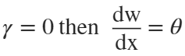
2.2 Constitutive equation

(2.2)
2.3 Equilibrium equations
The equilibrium equation can be formulated either by Galerkin's weighted residual method or, equivalently, by energy methods. In this study, we use the principle of virtual work, i.e.

(2.3)
Substituting (2.1) and (2.2) into (2.3) gives

(2.4)
3. Discretization and Element Stiffness

(2.5)
where
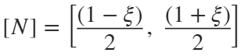
is the shape function in natural coordinates

are nodal variables.
The strain-displacement matrix relating the field variable and the nodal variable can be written as


Replace the field variables with their discretized version in (2.4), and we can write the element-level equilibrium equation in matrix form, i.e.

where

is the member's end-foce vector


4. Extension to Frame Element in 2D
The element stiffness can be simply extended to a frame element by adding an axial translation dof and the corresponding axial stiffness

The nodal variable is coupled through the shear stiffness matrix, i.e., is a full vector, whereas axial stiffness is uncoupled in the standard frame formulation. is equivalent nodal force vector due to member's force, i.e., distributed loads, prestressing, initial strain, etc.
The transformation matrix in the 2D plane is written as

where

and for nodal displacement, the transformation matrix can be written as

Then the stiffness matrix can be transformed into the global coordinates using

, for example and the force vector in the global coordinates is

Then the system equation can be obtained by assembling the element stiffness and nodal force vector, i.e.

Each row of the system equation represents the equilibrium at each node, and at common nodes, the stiffness and the equivalent nodal force are summed. This is a different approach from the Finite Difference Method, where each row represents the differential equation in discrete form (Oechner, 2021).
5. P-Delta Effect and Newton Iterative Loop
For a frame with lateral displacement, the second-order moment occurs, i.e.
. Then the virtual external work due to this second-order moment is

, by applying integration by part

This is caused by the element's axial force, and the displacement is not part of the strain energy, but the external force.

or in a discretized form

Now the equilibrium equation can be rewritten as

at any node, or

for the complete structure
The solution involving the P-Delta effect requires Newton iteration. The residual of force equilibrium is written as
where r_i is the imbalance force at load step i
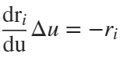
Then we can write the incremental equilibrium equation as

and

It's noted that the geometric has a destabilizing effect on the system stiffness. It should be stressed that only the member forces are used for stress calculation, i.e., for nonlinear material problems. shall be treated as part of the external nodal force, but adjusted by the displacement where the Newton iteration loop is applied.
6. Newmark Method for Direct Time Integration
The dynamic equilibrium equation of the structure, considering seismic excitation and P-Delta load effect at time t+1 can be written by

(6.1)
where are the mass and friction/damping matrix. Those matrices are usually diagonal for efficient processing by the reduction technique (Guyan, 1965; Bathe, 1996; Paz, 2004)
Applying the Newmark integration scheme with

turns (Oechsner, 2021) into a simple first order equation in terms of
displacement, i.e.,

where


The completed derivation can be found in major textbooks (Bathe, 1996; Oesner, 2021 ) for example.
7. Numerical Example
A 5-story rigid-framed structure is subjected to ground acceleration at base (Fig. 5.1). The properties of the material used for the beam and columns are listed below
E = 25e6; % kN/m2
G = 10e6; % kN/m2
kappa = 5/6;
rho = 25/9.81; % kN*s2/m4
% Set 1: column
b = 0.40; h = 0.40;
A = b*h;
I = b*h^3/12;
propSet(1).name = 'Column';
propSet(1).EA = E*A;
propSet(1).EI = E*I;
propSet(1).kGA = kappa*G*A;
propSet(1).rhoA = rho*A;
% Set 2: beam
b = 0.30; h = 0.50;
A = b*h;
I = b*h^3/12;
propSet(2).name = 'Beam';
propSet(2).EA = E*A;
propSet(2).EI = E*I;
propSet(2).kGA = kappa*G*A;
propSet(2).rhoA = rho*A;

Fig. 7.1 Ground acceleration data

Fig. 7.2 Deformed shape

Fig. 7.3 Analysis results for roof displacement, velocity, and acceleration
8. Conclusion
This study formulated a 2D shear-deformable Timoshenko frame element including axial, bending, shear, transformation, mass, damping, and geometric stiffness terms.
The MATLAB implementation demonstrated static and Newmark seismic dynamic analysis with user-defined section properties for beams and columns. The next phase of the study shall include nonlinear material analysis, especially the lumped plastic model.
9. References
Yogendra Singh (IIT Roorkee), Epicons Webinar 137 - Seismic Analysis of Tall Bldgs using Response Spectrum & Time History Methods, 2023
KJ Bathe, Finite Element Procedures, Prentice Hall, 1996
M Bischoff, Advanced Finite Element Method, Lecture notes at Technische Universität München, 2002
Mario Paz and William Leigh, Structural Dynamics: Theory and Computation, 5th Edition, Springer, 2004
A Oechsner, Computational Statics and Dynamics, Springer, 2021