

SLOPE-OP™: Slope Stability Analysis Using Circular and PCHIP* Slip Surface Optimization
- Adisorn O.
- 21 hours ago
- 2 min read

Adisorn Owatsiriwong
ALPS Consultants
Introduction
SLOPE-OP™ is an optimization-based slope stability analysis platform developed by ALPS Consultants. It combines classical limit equilibrium methods with modern metaheuristic optimization techniques to automatically identify critical slip surfaces.
The Philosophy Behind SLOPE-OP™
The objective is to locate the slip surface that produces the minimum Factor of Safety (FS) (Coduto 1999; Duncan 2014). Instead of relying on manual trial-and-error procedures, SLOPE-OP™ formulates the problem as an optimization task.
Circular Slip Surface Analysis
SLOPE-OP™ uses Simulated Annealing (SA) (Kirkpatrick et al., 1983) for circular slip surface optimization. A circular slip surface is defined by the circle center coordinates and radius. Simulated Annealing efficiently searches for the critical circular failure mechanism while avoiding local minima.
Design variables: xc,yc,r
Objective: min(FS)
constraints: minimum slice cut > N, i.e. 5
yc > ymax

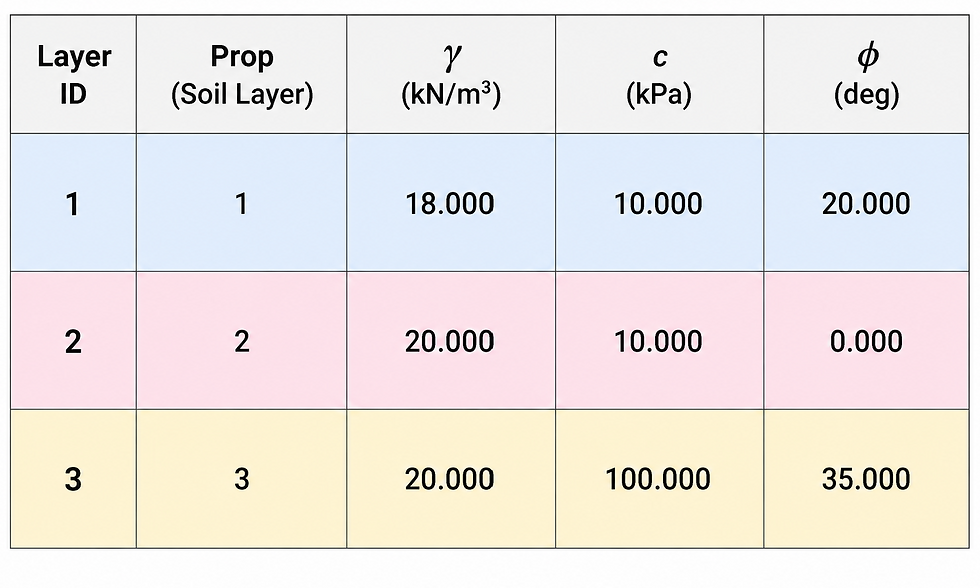
PCHIP* Slip Surface Analysis
*PCHIP = Piecewise cubic Hermite Interpolating Polynomial
SLOPE-OP™ uses the JAYA optimization algorithm for noncircular (PCHIP) slip surfaces. The software employs a shape-function-based representation of the slip surface, allowing smooth and physically meaningful failure mechanisms.
Design variables: q1,q2,...,qn ; q is depth measured from top surface of slope
n = number of sampling points < n_slice
Objective: min(FS)
constraints: minimum slice cut > N, i.e. 5
i.e., {di} = PCHIP(xi, q) ; geometric interpolation
Then, {yi} = {yt}-{di} ; {yt} = y at Top surface

Circular versus Noncircular Slip Surfaces
Circular analysis is suitable for homogeneous slopes and preliminary studies. Noncircular analysis becomes important when weak seams, soft layers, or geological interfaces influence the failure mechanism.
Why Noncircular Analysis Matters
In layered soil deposits, actual failures often follow weak layers. The noncircular optimization engine can naturally evolve toward these weak zones, producing more realistic critical slip surfaces than traditional circular searches.

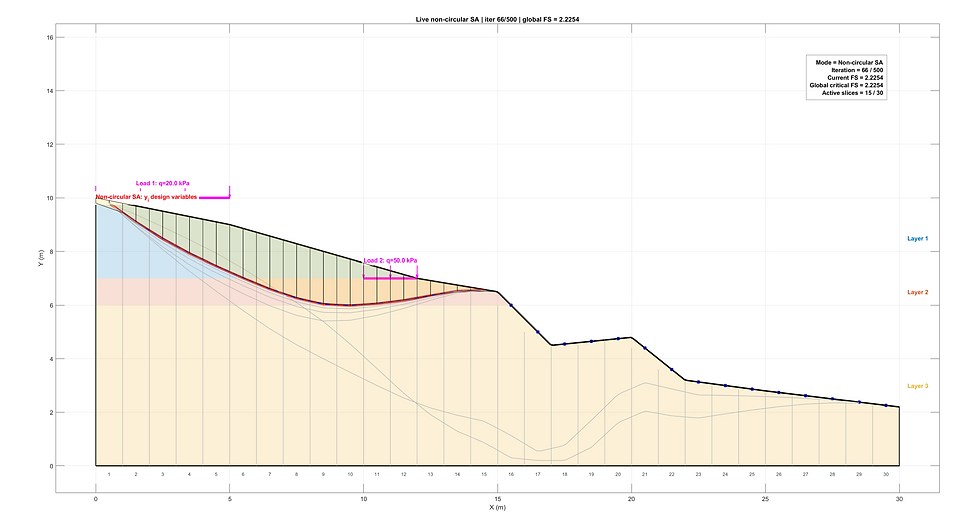
Shape-Based Noncircular Optimization
Instead of optimizing dozens of independent slip points, SLOPE-OP™ optimizes a small number of control depths and reconstructs the complete slip surface using smooth shape functions. This improves convergence and reduces numerical instability.
Practical Applications
SLOPE-OP™ can be applied to embankments, retaining structures, excavations, earth dams, landfill slopes, mine slopes, and natural terrain stability studies.
Conclusion
By combining the Fellenius Method of Slices, Simulated Annealing for circular slips, and JAYA (Rao, 2016) optimization for noncircular slips, SLOPE-OP™ provides a modern and practical solution for identifying critical slope failure mechanisms.
References:
S. Kirkpatrick, C. D. Gelatt Jr., and M. P. Vecchi (1983). "Optimization by Simulated Annealing." Science, 220(4598), 671-680. (This is the original paper that introduced the algorithm to computer science).
Rao, R. V. (2016). "Jaya: A simple and new optimization algorithm for solving constrained and unconstrained optimization problems." International Journal of Industrial Engineering Computations, 7(1), 19-34.
DP Coduto, Geotechnical Engineering: Principles and Practices, 1999
Duncan, J., Wright, S. and Brandon, T. (2014) Soil Strength and Slope Stability. 2nd Edition, John Wiley and Sons, Inc., Hoboken.
