

PILE-GRID™ An Automated FEM Platform for Pilecap-Beam Systems and Pile Deviation Assessment

Updated: Jun 29

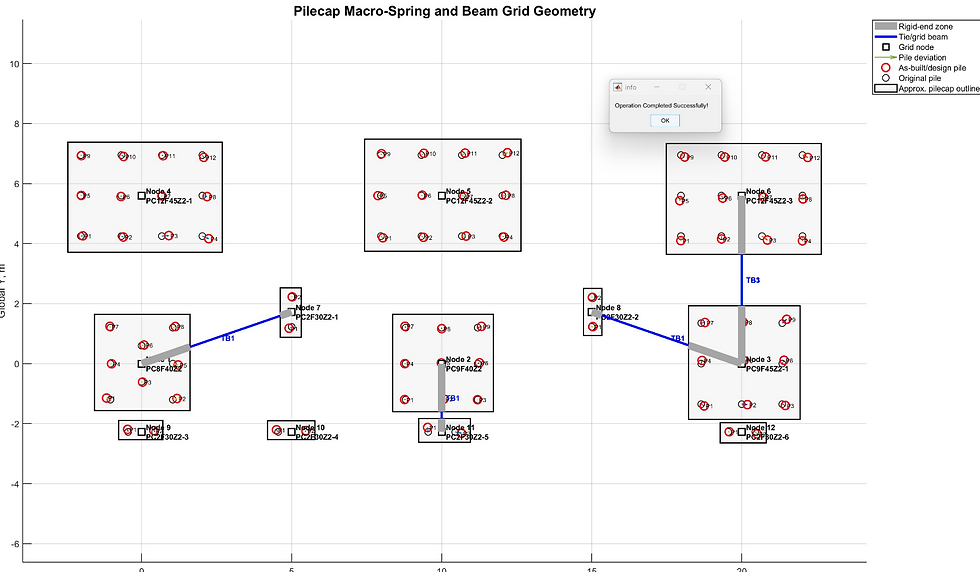
Figure. Rotated Pilecaps and Non-orthogonal strap beam grid (alps consultants, 2026)
Introduction to PILE-GRID™
Overview
PILE-GRID™ is an automated finite element analysis and design platform developed by ALPS CONSULTANTS to support the assessment, verification, and remedial design of pile foundation systems affected by pile construction deviations. The software was specifically created to address a practical gap in foundation engineering, where pile installation tolerances, positional deviations, and unexpected field conditions often require rapid engineering evaluation and decision-making.
Traditional pile deviation assessments are commonly performed using a combination of hand calculations, spreadsheets, simplified assumptions, and project-specific finite element models. Such approaches can be time-consuming, difficult to standardize, and challenging to apply consistently across multiple pile caps within large construction projects.
PILE-GRID™ provides a unified computational framework that integrates structural analysis, foundation equilibrium verification, ACI 318-25 reinforced concrete design checks, and automated reporting into a single workflow. Without unnecessary simplified assumption, the software enables engineers to evaluate the impact of pile deviations on pile cap behavior, elastic load redistribution, foundation flexibility, and the effectiveness of remedial measures such as strap beams and pile cap interconnection systems.

Figure GUI Windows (alps consultants, 2026)
Purpose
The primary objective of PILE-GRID™ is to assist engineers in making informed decisions regarding the acceptability of pile deviations and the necessity of corrective actions. The platform automates many of the repetitive and calculation-intensive tasks typically associated with foundation remediation studies while maintaining full engineering transparency and traceability.
The software is intended to support:
Assessment of pile position deviations after construction.
Evaluation of foundation equilibrium and stability.
Identification of unstable pile cap configurations.
Analysis of load redistribution caused by pile deviations.
Investigation of strap beam and tie beam interaction effects.
Verification of remedial foundation schemes.
Reinforced concrete design checks for pile caps and strap beams.
Preparation of engineering reports for design review and construction decision-making.
Analysis Methodology
PILE-GRID™ employs a finite element formulation based on shear deformable beam-grid structural modeling and elastic support representation of pile foundations. Rigid end offset is considered at each end of the beam for realistic connection of strap beam and pile cap. Individual pile caps may be connected through strap beams to simulate load transfer mechanisms commonly used in remedial foundation design.
The software automatically:
Efficiently compute using fast FEM solver for grid structure.
Computes pile reactions for both original and deviated pile configurations.
Evaluates shifts in foundation center of gravity.
Estimate end offsets from pile group topology
Verifies force and moment equilibrium.
Identifies rank-deficient or unstable foundation systems and remediation.
Allow for rotational restraints at support. Arbitrary rotating Pilecap and strap beams are possible via a sequential coordinate transformation.
Automatic assignment for rigid end connection between strap beam and Pilecap.
Quantifies load redistribution
between interconnected pile caps.
Assesses the contribution of strap beams to foundation stability.
Calculates design actions for reinforced concrete members.
The computational framework allows multiple pile caps to be analyzed simultaneously, making the platform particularly suitable for large-scale projects involving numerous pile groups.
The local stiffness of Timoshenko beam element can be written as
The Timoshenko beam stiffness is derived as follows
% Effective section stiffness
EI = E * Iz
GA = kappa * G * A;
% Shear stiffness reduction factor
% alpha = 0.5 by default, or user-defined
GAa = alpha * GA;
kb = [ ...
GAa/L, -GAa/2, -GAa/L, -GAa/2;
-GAa/2, EI/L + GAa*L/3, GAa/2, -EI/L + GAa*L/6;
-GAa/L, GAa/2, GAa/L, GAa/2;
-GAa/2, -EI/L + GAa*L/6, GAa/2, EI/L + GAa*L/3 ];
Where alpha is the shear stiffness reduction factor to avoid shear locking for a thin beam. Since the Clear_span/d of the strap beam is quite small, i.e.,> 5, shear locking is quite low compared to a thin beam or plate.
Note: From the grid system coordinate, w is positive upward, and theta is in the CW direction. Then the shear strain is computed from gamma = -dw/dx - theta
Design Capabilities
In addition to structural analysis, PILE-GRID™ includes integrated ACI 318-25 reinforced concrete design modules based on established engineering principles and code provisions. Design checks may include:
Flexural reinforcement design.
Shear reinforcement design.
Torsional reinforcement design.
Combined shear and torsion verification.
Minimum reinforcement requirements.
Punching shear assessment of pile caps.
Serviceability and equilibrium verification.
The solver supports arbitrary pile cap rotation and non-orthogonal strap beam alignment
Detailed design calculations and automated reports are generated to facilitate engineering review and documentation.

Figure. The pdf report for detailed analysis of pile force recovery, global & local equilibrium checks (alps consultants, 2026)
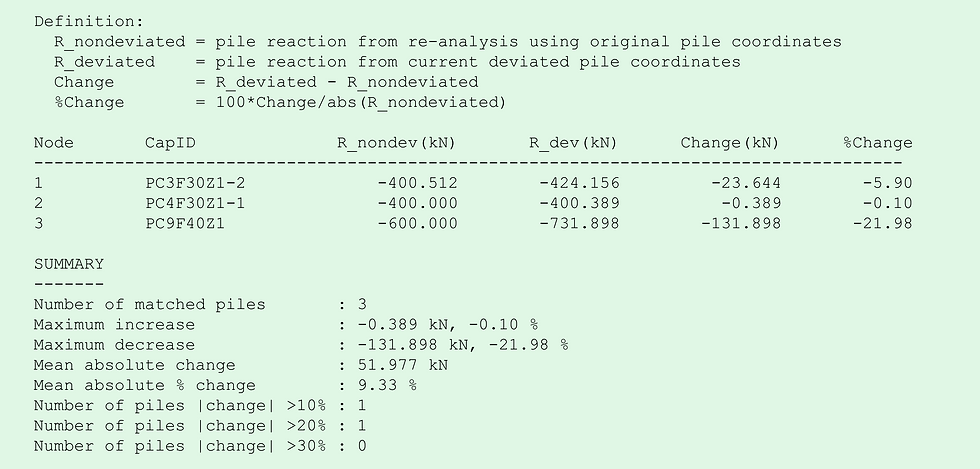
Figure. Pile deviaiton screening summary i.e. via control %Change
Intelligent Pilecap Geometry Optimization for Deviated Pile Systems
PILE-GRID includes an optional optimization module for the automatic generation of new pilecap boundaries after pile installation deviations have been identified. The feature is intended to reduce manual drafting effort and provide a rational, consistent pilecap geometry based on actual as-built pile locations.
For each pilecap, the program first computes the deviated pile coordinates:
X_i = X_{0,i} + dX_i
Y_i = Y_{0,i} + dY_i
The center of the pilecap is taken as the pilecap node location defined in the grid model. An optimization routine based on the JAYA algorithm then searches for the minimum-area rotated rectangular pilecap defined by:
Pilecap width (B_x)
Pilecap length (B_y)
Rotation angle (\theta)
subject to the constraint that every pile remains fully enclosed within the pilecap boundary. The minimum distance from each pile center to the nearest pilecap edge is maintained at not less than the specified pile diameter:
d_edge > dp
The optimization problem is formulated as:
min A = B_x B_y
subject to geometric containment constraints for all piles.
The resulting optimized pilecap dimensions and orientation are automatically exported to the standard DXF file. The generated drawing includes:
Optimized pilecap outline
Pilecap center marker
Pilecap identification label
Dedicated layer assignment (PILE_GRID_PILECAP)


see JAYA in acton! https://screenrec.com/share/GgHwFqaVQs
This feature transforms pile deviation assessment from a purely analytical task into a practical design workflow. Instead of manually redrawing pilecaps after construction deviations are discovered, engineers can automatically generate updated pilecap layouts directly from the analyzed pile configuration. The process improves consistency, reduces drafting time, and provides a repeatable computational workflow for deviation management and remedial pilecap design.
New Feature: Topology and Design Optimization of Strap Beams
One of the latest enhancements to the PILE-GRID platform is the introduction of an Automated Strap Beam Optimization module. The objective is simple: provide only the strap beams that are truly necessary to control pile reaction redistribution caused by pile deviations.
Traditionally, engineers evaluate deviated pile groups, identify overloaded piles, and then manually introduce strap beams between pile caps in an attempt to reduce excessive reactions. This process often involves multiple trial-and-error analyses and can result in unnecessary beams, excessive concrete volume, and increased construction cost.
The new automation module transforms this process into a systematic optimization problem.
Multi-Stage Optimization Strategy
The procedure begins by analyzing the pile system without strap beams to establish a baseline reaction distribution. The software then automatically generates candidate strap beams between adjacent pile caps while preventing unrealistic beam crossings.
A first-stage optimization searches for the minimum number of beams required to satisfy pile reaction redistribution criteria. The user specifies an allowable increase in pile reaction, for example 10%, and the optimizer determines which beam connections are actually needed.
Once the required beam layout has been identified, a second-stage optimization adjusts beam dimensions to achieve an economical design while satisfying structural requirements.
Integrated Structural Verification
Unlike purely geometric optimization methods, the final beam configuration is subjected to the full PILE-GRID finite element analysis. Beam actions are recovered directly from the compatibility-based model and checked for:
Flexure
Shear
Torsion
Combined shear and torsion stress
Only beam layouts that satisfy all structural requirements are accepted.


Modular Architecture
The optimization module is implemented as a separate add-on package that reuses the existing PILE-GRID analysis engine through MATLAB path management. This architecture avoids code duplication and allows future enhancements to be developed independently while benefiting from improvements made to the core solver.
Engineering Benefits
The automated strap beam optimizer offers several practical advantages:
Reduces manual trial-and-error design iterations
Minimizes unnecessary strap beams
Controls pile reaction redistribution caused by pile deviation
Produces structurally verified beam layouts
Generates final beam input files automatically
Supports CAD/DXF export of the optimized solution
Provides a scalable framework for future optimization modules
As PILE-GRID continues to evolve, this feature moves the platform beyond analysis and into true engineering decision automation, helping engineers identify efficient and constructible strap beam systems with significantly reduced effort.
Typical Applications
PILE-GRID™ is particularly useful for the following scenarios:
Post-construction pile deviation investigations.
Foundation remediation studies.
Strap beam design and verification.
Combined pile cap interaction assessment.
Construction quality assurance reviews.
Independent engineering checks.
Value engineering and remedial optimization studies.
Large projects requiring batch assessment of multiple pile caps.
Engineering Philosophy
PILE-GRID™ is founded on the principle that engineering decisions should be supported by transparent computational methods rather than blackbox fem package or subjective judgment alone. The platform does not replace engineering expertise; rather, it provides engineers with a rigorous analytical framework for evaluating foundation behavior and comparing alternative remedial solutions.
By combining rigorous finite element analysis, automated design checks, and comprehensive reporting, PILE-GRID™ transforms what is traditionally a labor-intensive and project-specific exercise into a repeatable, efficient, and technically defensible engineering workflow.
Actual Construction Case


Vision
PILE-GRID™ represents a new generation of specialized computational tools developed specifically for foundation engineering practice. Its purpose is to bridge the gap between field construction realities and analytical engineering assessment, enabling faster, more reliable, and more consistent decision-making for pile foundation systems.
PILE-GRID™ supercedes PILE-DEV™ by replacing isolated pile-deviation screening with a compatibility-based pilecap–strap beam FEM model. It evaluates pile reaction redistribution, beam force demand, rigid-end effects, and design consequences in one integrated workflow.

As the platform evolves, future developments may include advanced soil-structure interaction models, nonlinear foundation behavior, foundation dynamics and ground rocking, optimization-based remedial design, and integration with broader foundation engineering workflows.