

RWALL-OP™ Intelligent Retaining Wall Design with Explicit-Constraint Optimization Technology

Updated: Jun 27
A Modern Approach to Retaining Wall Engineering
RWALL-OP™ is a next-generation retaining wall design platform that combines advanced optimization technology with proven engineering analysis methods. The software is designed to replace traditional trial-and-error workflows with an intelligent and automated design process, helping engineers develop economical, practical, and reliable retaining wall solutions in significantly less time.
Whether for routine retaining wall projects or complex foundation systems, RWALL-OP™ provides a comprehensive environment for analysis, design, optimization, and documentation within a single platform.

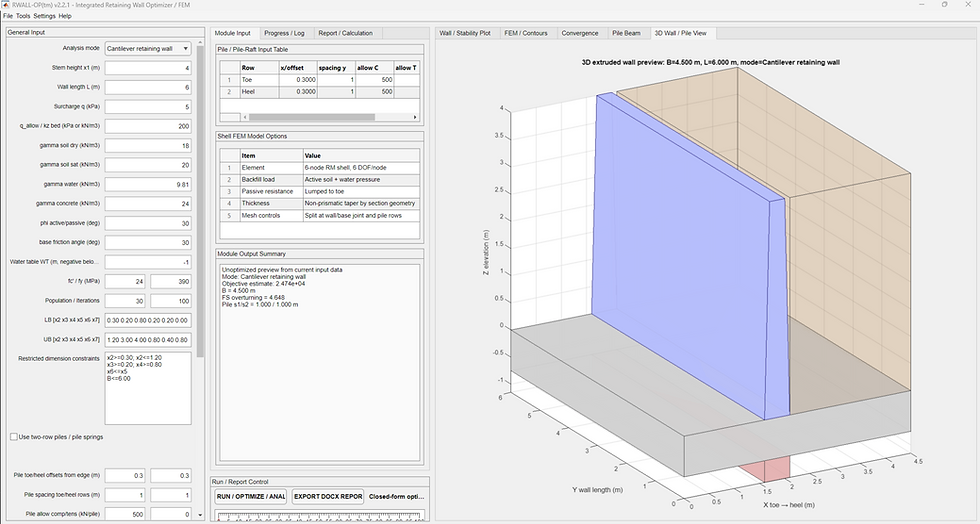
Multiple Analysis Options for Real Projects
RWALL-OP™ supports both classical and advanced engineering approaches to suit a wide range of project requirements.
Classical Rigid Wall Analysis
For conventional retaining wall design, the software provides fast and reliable rigid-body analysis for:
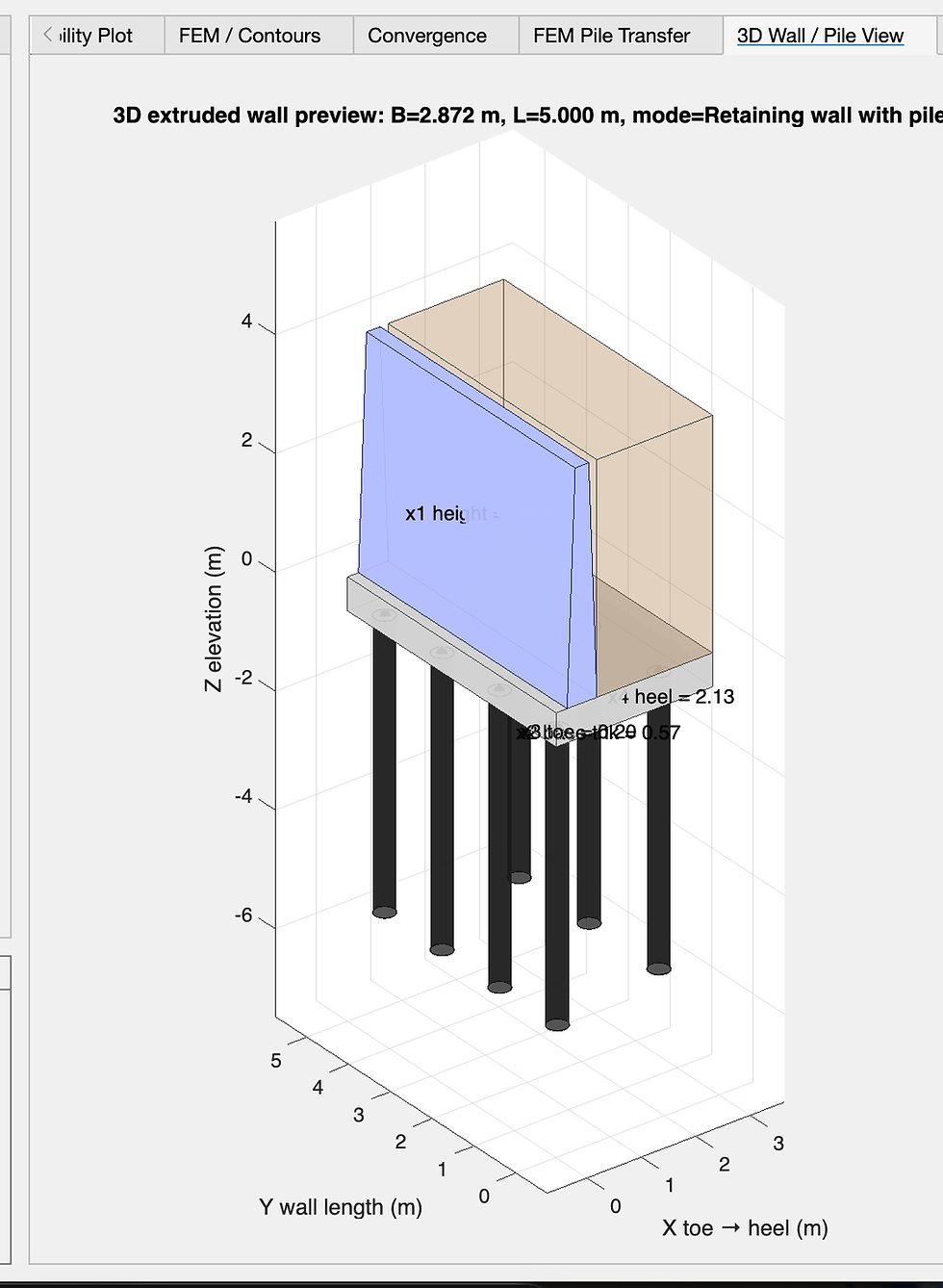
Retaining walls with pile foundations
Retaining walls without piles
Stability and equilibrium verification
Structural design checks using ACI 318-25 requirements
This approach is ideal for preliminary design, routine projects, and rapid engineering evaluations.
User-Defined Soil Layers and Library
The program supports multiple soil layers and automatically interpolates property values along the model's depth below grade. This can be applied to both mat spring and pile-supported retaining walls, enabling real practical applications.

Advanced Full FEM Analysis
For projects requiring greater accuracy, RWALL-OP™ includes our robust 4-node RM shell finite element modeling engine capable of simulating:
Reinforced concrete retaining wall behavior
Pile-supported retaining systems
Raft foundation systems
Soil-structure interaction effects
Realistic deformation and stress distributions
The FEM engine allows engineers to evaluate complex structural responses that cannot be captured using traditional rigid-body methods i.e. transverse moment and shear forces, deflection of the wall, shear and moment in piles.


Explicit Constraint-Optimization Technology
Explicit Engineering Constraints: A New Approach to Retaining Wall Optimization
One of the most innovative concepts under development in RWALL-OP™ is the introduction of Explicit Constraint-Optimization Technology. Traditional retaining wall software typically limits engineers to predefined design checks and fixed optimization parameters. In contrast, RWALL-OP™ aims to provide a framework where engineers can directly express project-specific requirements as mathematical constraints during optimization.
The system already supports numerous built-in constraints such as sliding stability, overturning stability, bearing pressure limits, concrete strength checks, pile capacity checks, and geometric limitations. However, future development will allow users to define additional engineering relationships that reflect practical design intent and construction requirements.
Examples of potential user-defined constraints include:
Geometric relationships:
Heel length ≥ 0.3 × wall height
Toe length ≤ heel length
Shear key depth ≤ 0.5 × foundation thickness
Stability requirements:
FS_slide ≥ 1.8
FS_overturn ≥ 2.0
Eccentricity ≤ B/6
qmax <= qall
Structural performance limits:
DCR_stem ≤ 0.85 (shear)
DCR_heel ≤ 0.75 (shear)
Pile foundation requirements:
P₂/P₁ ≥ 0.20 for redundancy
Pmax ≤ 80% of allowable capacity
DCR_pile ≤ 0.90
Constructability requirements:
Pile spacing ≥ 3 × pile diameter
This approach transforms optimization from a simple cost-minimization exercise into a practical engineering decision-support system. Engineers can explicitly guide the optimization process toward solutions that satisfy project constraints, owner requirements, construction preferences, and company design standards.
The long-term vision is for RWALL-OP™ to become one of the first retaining wall design platforms that combines advanced optimization algorithms, finite element verification, and user-defined engineering constraints within a single transparent workflow. Rather than forcing engineers to adapt their projects to the software, RWALL-OP™ is being developed to adapt the optimization process to real engineering practice.

Reliable and Transparent Engineering
RWALL-OP™ is developed with a strong emphasis on engineering transparency.
Every stage of the design process is clearly documented and traceable, including:
Load calculations
Earth pressure evaluations
Equilibrium checks
Stability analyses
Structural design verifications
Constraint evaluations
Optimization history
Convergence behavior
Engineers can fully understand how the final solution was obtained, providing confidence during design reviews and project approvals.
Professional Automatic Reporting
The software automatically generates comprehensive DOCX calculation reports suitable for engineering documentation and quality assurance procedures.
Reports can include:
Project information
Geometry definitions
Load calculations
Stability analyses
Structural design checks
Constraint verification
Optimization iterations
Objective function history
Convergence plots
Wall geometry illustrations
Final design summaries
The result is a complete engineering record that can be archived, reviewed, and submitted with project documentation.

Designed for Productivity
Despite its advanced analytical and optimization capabilities, RWALL-OP™ is designed to remain practical and easy to use.
The streamlined workflow enables engineers to:
Define project geometry and constraints.
Select the preferred analysis model.
Run analysis and optimization.
Review results and design checks.
Generate professional reports.
This approach minimizes repetitive manual work while maintaining full engineering control over the final design.
Key Features
Analysis
Classical rigid retaining wall analysis
Cantilever wall design with or without piles
Full shell finite element analysis
Pile and raft foundation modeling
Soil-structure interaction assessment
Optimization
Automatic wall geometry optimization
Explicit site constraint handling
Material and cost reduction strategies
Practical constructability considerations
Verification
Stability and equilibrium checks
Structural design verification
Transparent calculation procedures
Detailed engineering outputs
Documentation
Automatic DOCX report generation
Detailed calculation summaries
Optimization history and convergence records
Engineering-quality project documentation
EXAMPLE:
Fixed Design Check Mode (No Optimization Run)
RWALL-OP 2.6.34 now includes a Fixed Design Check mode for rapid verification of user-defined retaining wall dimensions without running the optimization engine. Engineers can directly specify all design variables (such as wall geometry and pile parameters, if applicable) and execute the same analysis engine used during optimization. The program computes all state variables, including earth pressures, stability factors, bearing pressure, reinforcement requirements, DCR values, equilibrium checks, and explicit constraint evaluations. This feature is particularly useful for reviewing existing designs, checking manually developed alternatives, performing code verification, or comparing optimized and non-optimized solutions while maintaining a single, transparent analysis workflow.


Automatic DXF Construction Drawing Export
RWALL-OP now includes an automatic 2D DXF drawing export to bridge the gap between engineering analysis and practical drafting. After completing either an optimization or a fixed design check, the program can generate a construction-ready DXF file containing the retaining wall geometry, footing, stem, shear key, pile layout (if applicable), dimension lines, soil profile, design summary, and an initial reinforcement arrangement. Although intended as a first-version drawing, the generated DXF is already suitable as a strong starting point for construction documentation, allowing engineers to complete the final detailing in AutoCAD or compatible CAD software with significantly less manual drafting. This feature is part of our vision to transform engineering software from a calculation tool into a complete design automation platform.

Why RWALL-OP™ Is Different
RWALL-OP™ is more than a retaining wall design program—it is an integrated analysis, verification, and optimization platform developed specifically for modern geotechnical and structural engineering applications.
Unlike conventional retaining wall software that relies solely on predefined calculations and trial-and-error sizing, RWALL-OP™ combines explicit optimization algorithms with multiple analysis models, allowing engineers to automatically search for efficient solutions while satisfying project-specific constraints such as geometry limits, site restrictions, stability requirements, structural capacity, and constructability considerations.
The platform supports both traditional rigid retaining wall analysis and advanced finite element modeling using Reissner-Mindlin shell elements with soil-structure interaction and pile foundation systems. This enables engineers to rapidly optimize a practical preliminary design and then refine the final solution using a more detailed FEM model within the same workflow.
A key feature of RWALL-OP™ is its emphasis on transparency and engineering verification. The software continuously checks global equilibrium, support reactions, soil and pile load transfer, structural demand-to-capacity ratios, and design code requirements, providing engineers with a clear understanding of the load path rather than simply presenting final answers.
By combining optimization, advanced FEM analysis, explicit engineering constraints, automated reporting, and full design transparency, RWALL-OP™ represents a new generation of retaining wall design technology to improve safety, efficiency, and engineering productivity.
Engineering Design Beyond Analysis
RWALL-OP™ is more than a retaining wall analysis program. It is a complete engineering optimization platform that integrates structural analysis, geotechnical evaluation, practical site constraints, and automated design intelligence into a single workflow.
The result is faster design development, improved transparency, greater confidence in engineering decisions, and more economical retaining wall solutions for real-world projects.