

EASY-TANK™ Version 1.149 Released – Major Advances in Geometry Modeling, Parallel Computings and Engineering Workflow

Updated: Jun 22
ALPS Consultants is pleased to announce the release of EASY-TANK™ Version 1.149, representing one of the most significant upgrades since the introduction of the software. This revision focuses on improving modeling flexibility, practical engineering workflow, visualization quality, and documentation output for reinforced concrete tank and underground structure design.
Arbitrary Wall Model Generator
A major enhancement in Version 1.149 is the introduction of the Arbitrary Wall Model Generator. Engineers are no longer limited to regular rectangular tank layouts. Complex wall geometries can now be modeled directly, allowing EASY-TANK™ to represent practical structures such as irregular tanks, chambers, underground utility structures, pump stations, and specialized containment facilities.
This capability significantly expands the range of projects that can be analyzed using the software while maintaining the simplicity of the automated workflow.

DXF Import & Export Functionality
To further streamline model creation, EASY-TANK™ now supports DXF geometry import. Engineers can prepare layouts in their preferred CAD environment and import them directly into the software.
The imported geometry is automatically converted into the analysis model, reducing manual input, minimizing modeling errors, and accelerating project setup. This feature is particularly beneficial for projects involving complex layouts or frequent design revisions.
Bearing Pressure Visualization for Spring-Supported Foundations
For models utilizing spring-supported foundation systems, EASY-TANK™ now provides detailed visualization of bearing pressure distribution beneath the structure.
This enhancement allows engineers to quickly assess soil-structure interaction behavior, identify areas of pressure concentration, and verify that foundation reactions remain within acceptable limits. The graphical presentation improves interpretation of results and assists in engineering decision-making.

Water Pressure Assignment on Internal Partition Walls
Version 1.149 introduces improved handling of internal partition walls, including automatic assignment of hydrostatic pressure effects.
This capability enables more realistic simulation of multi-cell tanks and compartmentalized structures where water levels and pressure distributions interact with internal walls. The enhancement improves accuracy and reduces the need for manual load definition.
FEM and Parallel Computing using OpenMP™
Recent development work on EASY-TANK™ has focused on establishing a new computational framework based on finite element analysis (FEM), parallel computing, and automated reinforced concrete design procedures.
The latest implementation introduces a unified Fortran computational engine capable of performing the complete structural analysis workflow, including element stiffness generation, global matrix assembly, sparse system solution, element force recovery, Wood-Armer moment processing, reinforcement demand calculations, and concrete shear verification.
To improve scalability and prepare for larger finite element models, the computational engine has been developed with OpenMP parallel computing infrastructure. Element-level operations such as stiffness generation and result recovery are structured to support multi-core execution, providing a foundation for future performance improvements as model sizes continue to grow.

The current workflow consists of:
• Finite element mesh generation and preprocessing• Element stiffness matrix formation• Global sparse matrix assembly• Iterative sparse system solution using a PCG solver• Element force recovery and stress result extraction• Wood-Armer moment transformation• Reinforced concrete design calculations• Automated report generation and visualization
In this architecture, MATLAB is primarily responsible for graphical user interaction, visualization, and report generation, while the numerical analysis and design calculations are executed within the dedicated computational engine.
Although developed initially for reinforced concrete tank structures, the underlying framework is intended to support future engineering applications involving plates, shells, foundations, retaining structures, anchorage systems, and optimization-based design tools.
This development represents an important step toward a unified engineering computation platform where finite element analysis, code-based design verification, optimization, and automated reporting are integrated into a single workflow.

Enhanced Visualization and Plotting
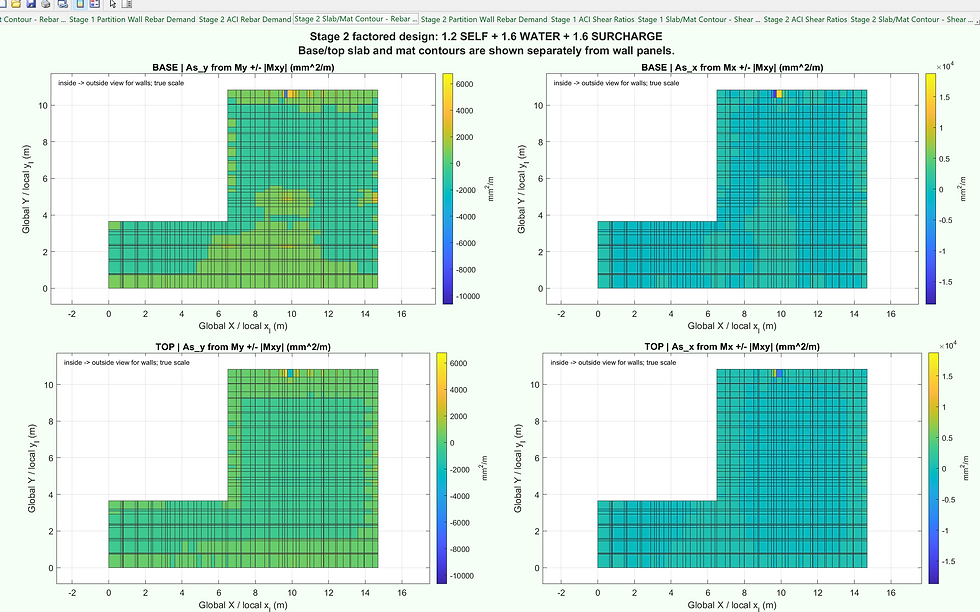
Significant effort has been invested in refining the graphical output of EASY-TANK™. Structural response plots, contour displays, deformation visualizations, and model graphics have been improved to provide clearer interpretation of analysis results.
The updated plotting system delivers a more professional presentation while helping engineers identify critical design regions more efficiently.
Improved Documentation and Reporting
Documentation output has also received major attention in this release. Reports now include more comprehensive project information, improved formatting, clearer presentation of analysis results, and enhanced graphical content.
The objective is to provide engineers with documentation that is not only technically complete but also suitable for project records, client submissions, and design review purposes.


Continuing Development
EASY-TANK™ continues to evolve as part of ALPS Consultants' vision of integrating finite element analysis, structural design, optimization, and engineering automation into a unified workflow. Version 1.149 represents another step toward reducing repetitive engineering tasks while improving reliability, transparency, and productivity in tank and underground structure design.