

ANCHOR-OP™ Version 1.43 Released: Transforming Base Plate and Anchor Design

Updated: Jun 22
We are pleased to announce the release of ANCHOR-OP™ Version 1.43, representing a significant advancement in the analysis and design of anchor bolt systems, column base plates, and steel-to-concrete connections.
This update introduces a range of new technologies that improve modeling accuracy, automation, optimization capability, and reporting quality while maintaining a clear and transparent design workflow based on ACI 318-25 and modern structural engineering practice.
Major New Features
Flexible Base Plate Analysis Using FEM Shell Elements
ANCHOR-OP™ now supports advanced finite element modeling of base plates using shell elements. Unlike conventional rigid-plate assumptions, the software can evaluate realistic plate behavior, stress distribution, deformation patterns, and load transfer mechanisms between steel and concrete.
Built-In Steel Section Profiles
Standard structural steel profiles can now be assigned directly to the connection model, including:
H-Beam Sections
Rectangular and Square Tube Sections
This allows engineers to model practical column base plate connections more efficiently and accurately.

Automatic Base Plate Dimension
The software can automatically determine suitable plate dimensions through an internal optimization process. This feature operates behind the scenes and reduces the need for manual trial-and-error sizing by the user.
Intelligent Automatic Meshing
A new geometry-aware meshing engine automatically generates finite element meshes based on:
Base plate geometry
Anchor bolt locations
Connection configuration
The result is improved analysis quality with minimal user input.
Compression-Only Spring Modeling
Concrete bearing beneath the base plate is represented using compression-only nonlinear springs. An iterative nonlinear solution algorithm automatically identifies active contact regions and provides a more realistic representation of plate-concrete interaction.

Enhanced Concrete Breakout Detection
Significant improvements have been made to the concrete breakout evaluation engine, allowing more reliable identification of:
Edge breakout conditions
Group breakout behavior
Complex anchor arrangements
Multiple failure surface interactions

Plate Thickness Optimization (Testing Phase)
A new optimization module is currently being evaluated which automatically determines economical plate thicknesses based on:
AISC 360 requirements
FEM stress distributions
Strength and serviceability criteria
This feature is presently under testing and will continue to be refined in future releases.
Improved Visualization and Plotting
Graphical output has been substantially enhanced to provide clearer interpretation of:
Anchor forces
Contact pressure distributions
Plate deformation
Stress contours
Failure mechanisms
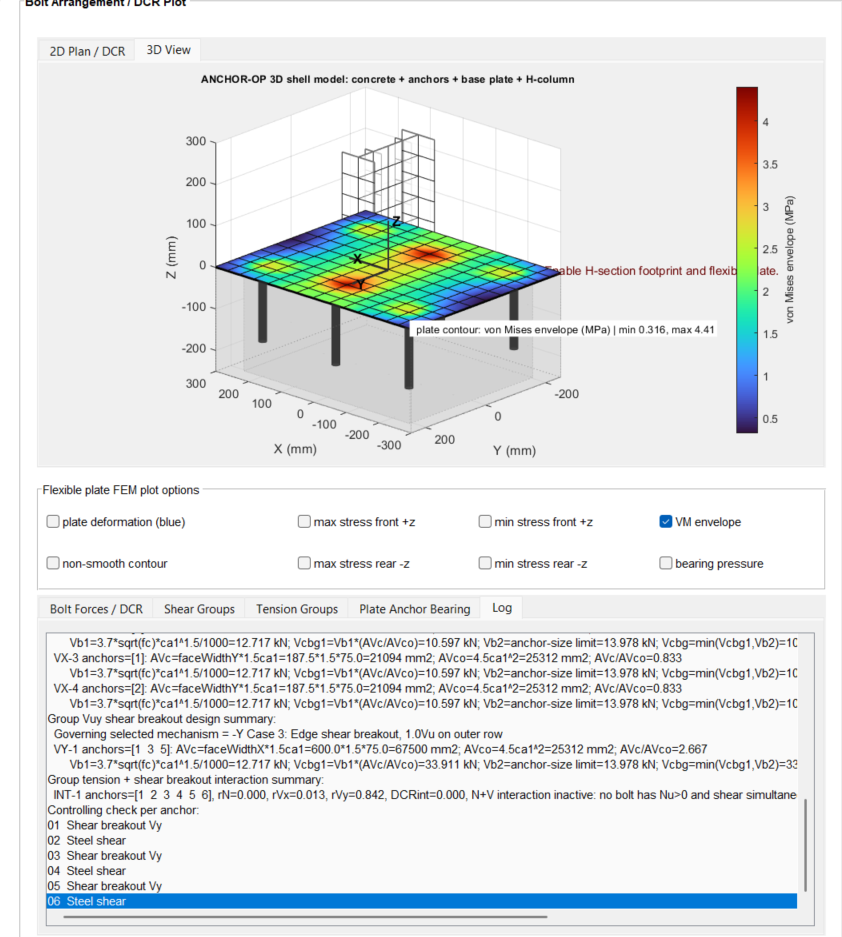

Enhanced DOCX Reporting
Reporting capabilities have been upgraded with improved DOCX generation, producing professional engineering reports that are easier to review, edit, and incorporate into project documentation.
Suitable Applications
With Version 1.43, ANCHOR-OP™ is now well suited for the design and verification of:
Steel column base plates
Equipment foundations
Structural steel supports
Steel-to-concrete connections
Anchor bolt groups subjected to axial load, shear, moment, and combined loading
Features Under Development
Development continues toward a more comprehensive steel connection platform. Planned enhancements include:
Stiffener Plate Modeling
Analysis and design of base plate stiffeners to improve force transfer and reduce plate thickness requirements.
DXF Import and Export
Direct import of connection geometry from CAD drawings and export of optimized configurations for detailing workflows.
Simplified Calculation Reports
A streamlined reporting format focused on engineering review efficiency while retaining complete design traceability.
Looking Forward
ANCHOR-OP™ continues to evolve from a conventional anchor design program into an integrated analysis, design, and optimization platform for steel-to-concrete connections. Our objective remains the same: provide engineers with transparent calculations, advanced analysis capabilities, intelligent optimization tools, and reliable design decisions within a practical engineering workflow.