

CORBEL-STM™ Strut-and-Tie Modeling and Optimization for Reinforced Concrete Corbels According to ACI 318-25

Updated: Jul 9
Adisorn Owatsiriwong
ALPS CONSULTANTS
Introduction
Reinforced concrete corbels are among the most challenging structural elements to design correctly. Although relatively small in size, corbels are subjected to highly concentrated loads and complex stress distributions that cannot be accurately represented using conventional beam theory.
In precast concrete construction, industrial facilities, bridge structures, transfer systems, and heavy equipment supports, corbels play a critical role in transferring large vertical and horizontal forces into supporting columns. Failure to properly evaluate force flow within the corbel may result in unsafe reinforcement detailing, excessive congestion, or inefficient designs.
To address these challenges, ALPS Consultants has developed CORBEL-STM™, an advanced Strut-and-Tie Modeling and Optimization Tool based on the requirements of ACI 318-25. The system combines modern structural engineering principles with intelligent optimization techniques to automate design while maintaining transparency and code compliance.


The Necessity of Advanced Corbel Design
Traditional reinforced concrete beam design methods assume a linear strain distribution and are generally applicable to slender members where stresses can be idealized through sectional analysis.
Corbels do not behave this way.
Typical corbels exhibit:
Very small shear span-to-depth ratios (a/d)
Significant compression strut action
Concentrated bearing forces
Complex stress trajectories
Localized nodal zones
High reinforcement congestion
These characteristics create what structural engineers classify as a Disturbed Region (D-Region).
Within a D-region:
Bernoulli beam assumptions are no longer valid.
Internal stresses become highly nonlinear.
Load transfer occurs through direct compression and tension force paths.
As a result, traditional flexural and shear design procedures alone are insufficient to fully represent the actual behavior of the structure.


ACI 318-25 Requirements for Corbel Design
ACI 318-25 recognizes corbels as discontinuity regions and requires engineers to evaluate load transfer mechanisms appropriately.
The code requires consideration of:
Strength Requirements
Factored vertical load (Vu)
Factored horizontal load (Nu or Hu)
Combined force effects
Bearing stresses
Development and anchorage of reinforcement
Reinforcement Requirements
Primary tension reinforcement
Horizontal ties
Shear-friction reinforcement
Minimum reinforcement provisions
Proper anchorage beyond critical sections
Strut-and-Tie Method (STM)
For deep members and discontinuity regions, ACI 318-25 Chapter 23 explicitly permits and encourages the use of Strut-and-Tie Modeling (STM) when av/h < 2
The STM approach provides a rational representation of internal force flow and is particularly well suited for corbels because it directly models:
Compression struts
Tension ties
Nodal zones
Equilibrium of forces
rather than relying solely on sectional assumptions.
ACI 318-25 Chapter 16.5 Approach
For a beam ledge or corbel with av/d < 1.0, the ACI 318*25 Chapter 16.5 approach can be applied.
ACI 16.5.2.4
The maximum Vu is min(0.2fc'*b*d, (3.3+0.08fc')*b*d, 11bd).
ACI 16.5.5.1
The area of primary tension reinforcement, Asc shall be
Asc = max(Af+An, 2/3Avf + An, 0.04fc'/fy*bd)
ACI 16.5.5.2 The area of closed stirrups or ties parallel to primary tension reinforcement with in top 2/3d
Ah = 0.5*(Asc-An)
ACI 16.5.6.3
At the front face of a bracket or corbel, primary tension reinforcement shall be anchored by
(a) A weld to a transverse bar of at least equal size that is designed to develop fy of primary tension reinforcement, OR
(b) Bending the primary tension reinforcement back to from a horizontal loop, OR
(c) Other means of anchorage to develop fy
ACI 16.5.6.4, 16.5.6.5
Primary tension reinforcement shall be developed at the face of the support. The develop of tension reinforcement shall be full along the distance.
ACI 16.5.6.6
Closed stirrups or ties shall be spaced such that As is uniformly distributed within (2/3)d measured from the primary tension reinforcement
ACI 1.6.5.4.2
∅ = 0.75 is used for all failure mode of beam ledge and corbel according to ACI 21.2
Understanding Strut-and-Tie Modeling
The Strut-and-Tie Method may be viewed as a truss analogy of the internal stress field.
Instead of assuming stresses are distributed according to beam theory, STM idealizes the load path using:
Compression Struts
Concrete regions carrying compressive forces.
Examples include:
Diagonal compression struts
Horizontal compression struts
Column compression zones
Tension Ties
Reinforcement carrying tensile forces.
Examples include:
Main corbel reinforcement
Horizontal reinforcement
Vertical tie reinforcement
Nodal Zones
Regions where struts and ties intersect.
Node capacities depend on:
Stress conditions
Geometry
Confinement
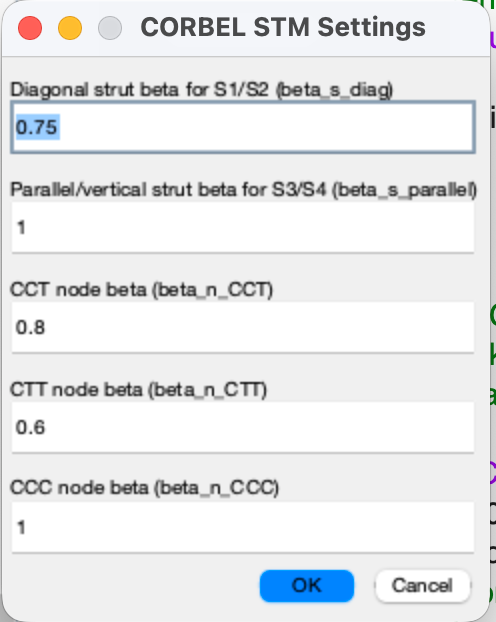
ACI effectiveness factors (βn)
Common node types include:
CCC
CCT
CTT
The objective of STM is to ensure:
Force equilibrium
Adequate strut capacity
Adequate tie capacity
Adequate node capacity
throughout the entire load-transfer mechanism.
This approach closely reflects the actual physical behavior of reinforced concrete.
Color-Coded Demand-to-Capacity Visualization
To facilitate rapid engineering review, CORBEL-STM™ displays color-coded performance indicators:
Green
Satisfactory performance (DCR < 0.6)
Orange
Approaching capacity (0.6 < DCR < 0.9)
Red
Exceeds allowable capacity (DCR > 0.90)

Intelligent Optimization for Automatic Design
While STM provides an accurate framework, practical implementation can be tedious.
Engineers often spend considerable time determining:
Corbel width
Corbel depth
Reinforcement areas
Reinforcement layouts
Tie dimensions
Nodal capacities
Constructability constraints
Many trial-and-error iterations may be required before reaching an acceptable solution.
CORBEL-STM™ introduces an intelligent optimization engine that automates this process.
The system evaluates thousands of candidate designs and automatically searches for solutions that satisfy:
Structural Constraints
Tie strength requirements
Strut strength requirements
Node strength requirements
Bearing requirements
Reinforcement limits
Practical Constraints
Geometric limitations
Reinforcement detailing requirements
Constructability considerations
Economic Objectives
Concrete volume
Reinforcement quantity
Overall material cost
The result is a design that is both code-compliant and economically efficient.
Rather than merely checking a manually selected design, CORBEL-STM™ actively searches for improved alternatives.


Innovation for Special Structural Applications
Many structural elements can be interpreted as discontinuity regions.
The underlying STM framework implemented in CORBEL-STM™ provides a foundation for analyzing and optimizing more complex structures such as:
Precast Connections
Beam-seat corbels
Pocket connections
Industrial precast supports
Transfer Regions
Load transfer zones
Deep beam supports
Equipment foundations
Heavy Industrial Structures
Crane supports
Pipe rack supports
Machinery foundations
Customized Structural Components
Unique architectural supports
Non-standard load paths
Special anchorage regions
Because the methodology is based on force flow rather than predefined beam formulas, it can be adapted to many specialized engineering problems where conventional approaches become inadequate.
This flexibility opens opportunities for future development of automated STM-based design systems for a broad range of reinforced concrete applications.
Engineering Transparency
A major objective of CORBEL-STM™ is not merely automation, but engineering transparency.
The software provides:
Detailed STM force paths
Strut force calculations
Tie force calculations
Nodal stress checks
Capacity utilization ratios
Comprehensive design reports
This allows engineers to understand how a solution is obtained and verify compliance with ACI 318-25 requirements.
Automation should enhance engineering judgment—not replace it.
Conclusion
As reinforced concrete structures become more specialized and project schedules become increasingly demanding, engineers require tools that combine rigorous structural mechanics with efficient computational methods.
CORBEL-STM™ was developed to bridge that gap.
By integrating:
ACI 318-25 provisions,
Strut-and-Tie Modeling principles,
Automated optimization techniques,
Practical engineering constraints,
the system enables engineers to produce safer, more economical, and more transparent corbel designs.
The future of structural engineering lies not only in analysis, but in intelligent design automation. CORBEL-STM™ represents another step toward that future.
CORBEL-STM™AI-Assisted Strut-and-Tie Modeling and Optimization for Reinforced Concrete Corbels
Developed by ALPS ConsultantsStructural Engineering • Numerical Optimization • Design Automation
References:
ACI318-25, Building Code Requirements for Structural Concrete: Chapter 23 Strut-and-Tie Method
A Muttoni, J Schwartz, B Thuerlimann, Design of Concrete Structures with Stress Fields, Birkhauuser, 1997
SE El-Metwally, WF Chen, Structural Concrete: Strut-and-Tie Models for Unified Design, CRC Press, 2018
A Owatsiriwong, Strut-and-Tie-Modeling in Reinforced Concrete Structures: Basics and Applications, 2013 (PDF) Strut and Tie Modeling in Reinforced Concrete Structures,