

PILE-DEV™ Pile Group Deviation Analysis: Intelligent Engineering Tool for Real-World Pile Construction Deviations

Updated: May 29
In modern foundation construction, pile deviation is unavoidable. Survey tolerances, drilling shifts, obstruction avoidance, and site limitations often cause pile positions to deviate from the original design layout. Traditionally, engineers must manually evaluate these deviations, revise pile reactions, check eccentricities, and redesign pile caps — a process that is time-consuming, repetitive, and highly dependent on engineering judgment.

Our PILE-DEV Deviation Analysis Tool (ALPS Consultants, 2026) was developed to solve this challenge systematically.
The platform automates the evaluation of pile deviations and provides engineers with a rapid and rational basis for decision-making during construction and redesign stages.
Key Capabilities
Automated Pile Reaction Recalculation
The software automatically computes updated pile reactions considering:
Actual pile coordinates
Applied axial load and moments
Eccentricity effects
Redistribution due to shifted pile locations
This allows engineers to immediately assess whether the deviated pile arrangement remains structurally acceptable.
Instant Identification of Critical Piles
The system highlights:
Maximum compression piles
Uplift/tension piles
Overstressed locations
Reaction imbalance
This significantly reduces manual spreadsheet checking and improves reliability during site decisions.
Batch Processing for Multiple Pile Caps
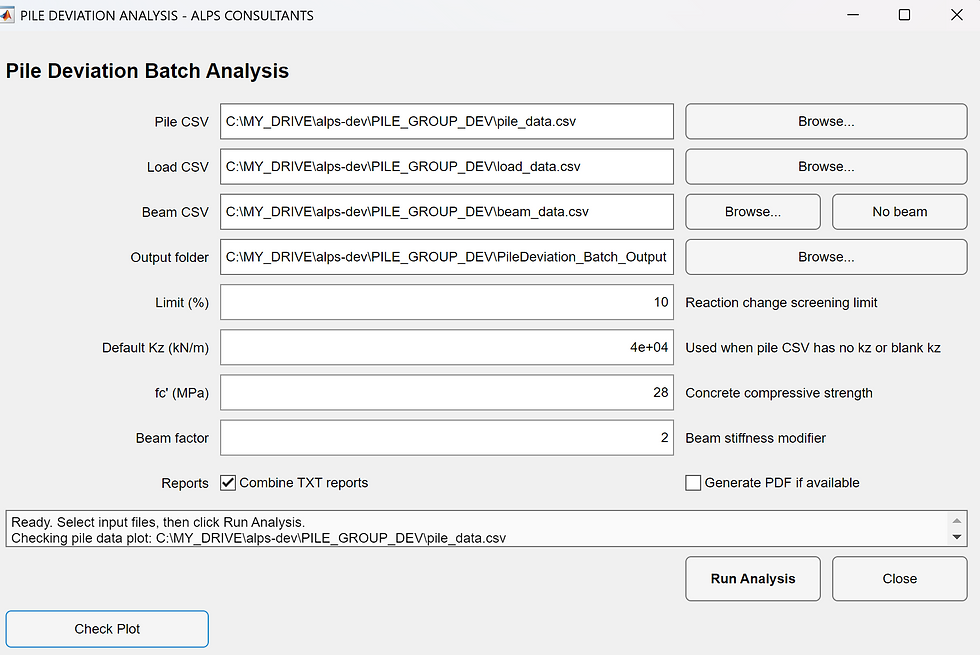
Large projects may contain hundreds of pile caps.PILE-DEV supports batch evaluation directly from CSV input files, enabling:
Rapid review of multiple foundations
Consistent engineering checks
Significant reduction in engineering hours


Visual Engineering Interpretation
The tool generates engineering plots for:
Original vs deviated pile layouts
Pile reaction distributions
Load eccentricity visualization
Critical pile identification
This improves communication between design engineers, contractors, and site teams.

Fig. Summary Table for Analysis Results
Stiffening Beam

Stiffening beams can be included where vertical shear stiffness is released for safe design. The condensed rotational stiffness of EI/L and torsional stiffness GJ/L are added to the pilecap diagonal element according to the direction of the beam connecting to the pilecap.

The grid beam can be aligned at any horizontal angle (alpha); then the stiffness is transformed into the global system as in standard FEM.

The member end forces are multiplied by the load factor for flexural and shear design, as a post-processing step, following ACI318-19.
After computing end moment, shear and torsion, then the beam section is checked in accordance with ACI318-19, shear and torsion for example

It should be noted that ACI 318 uses Ao in order to bring higher torsional stress i.e. Ao = 0.85Aoh for rebar design. Howver, for combined stress check, Aoh is allowed.
Pilecap Design (ACI 318-19)
Shifting of pile group CG can cause a significant change of transferred forces (Vu, Mu) at the pilecap. Therefore, those updated internal forces shall be considered for redesign. Our tool reads pile reactions from the deviated system, recalculates the required reinforcement, and performs shear checks at critical sections. The design module is similar to PILE-OP's.
Solved Cases
PILE-DEV has been used to investigate and provide remedy solutions for numerous construction projects in Thailand. It demonstrates efficiency and becomes a new standard computational tool for this typical foundational problem.


Documentations
The report is autogenerated after the calculation process. The calculation consists of 2 parts: pile reaction analysis and strap beam design in accordance with ACI 318-19.
This automatic process significantly saves a considerable amount of resources for the final submission. So the engineer would rather focus on the real workflow rather than the tedious process.


Built for Practical Engineering
The development philosophy behind
PILE-DEV focuses on:
Fast computational performance
Transparent engineering logic
Expandable architecture
Integration with future optimization and FEM workflows
Unlike black-box software, the methodology remains understandable and verifiable by practicing engineers.
Future Development
Upcoming developments include:
FEM-based stiffness interaction (PILE-GRID project is in progress)
Optimization-assisted pile arrangement studies
PILE-DEV — Engineering Intelligence for Foundation Systems.
PILE-DEV automates pile deviation assessment by recalculating pile reactions, identifying critical piles, visualizing deviations, and efficiently processing multiple pile caps. It reduces manual checking time, improves consistency, and provides a scalable engineering workflow for real-world foundation construction problems.