

PILE-TOOLBOX™: An Integrated Platform for Practical Pile Foundation Design using Intelligent Optimization

Updated: Jul 6
Adisorn Owatsiriwong
ALPS CONSULTANTS
Introduction
Pile foundations are among the most critical components of any structure, directly influencing safety, serviceability, construction cost, and long-term performance. Despite their importance, engineers often rely on multiple spreadsheets and standalone programs to evaluate pile capacity, settlement, lateral behavior, and pile group configurations. This fragmented workflow increases design time and makes optimization difficult.
PILE-TOOLBOX was developed to provide a unified engineering platform for pile foundation analysis, visualization, and optimization. Rather than focusing solely on ultimate pile capacity, the software integrates strength, serviceability, and economic considerations into a single workflow, allowing engineers to evaluate multiple design alternatives efficiently.
The best thing about this tool is that most of the data is synced among the calculation modules; for example,
Soil layer data are shared through all modules.
The allowable load of the pile group can be sent to the settlement calculation
The pile group dimension can be transferred to the p-y analysis
The maximum moment and shear obtained from the p-y analysis can be transferred to the PN Pier for interaction strength checks and detailing work.
This unification of data helps to smooth the design workflow and remove errors in using different data for different but correlated analysis tasks.
Key Features
Axial Pile Capacity Analysis
PILE-TOOLBOX supports layered soil profiles consisting of both clay and sand. The program employs empirical design methods widely used, including alpha value for Bangkok clay, enabling engineers to rapidly estimate shaft resistance, end bearing, and allowable pile capacity using familiar engineering procedures. Soil properties can be defined layer by layer, making the software suitable for realistic site investigations.


The value of the friction angle (sand) can be inferred from the N value. The N value at each stratum is converted to the standard value using N/ = 0.77*log(2000/sig_effective). The program will take care of this internally.
Elastic Settlement & Consolidation Analysis
Foundation performance is governed not only by strength but also by settlement. PILE-TOOLBOX includes an elastic settlement module based on Boussinesq's stress distribution theory, allowing engineers to estimate settlement caused by stress increase within layered soils. Graphical settlement profiles with depth provide valuable insight into deformation mechanisms and serviceability performance.
The consolidation analysis is done for clay layers through log(sigma_v') - settlement relationship. Each layer is discretized into 10 sub-layers for accuracy. The value at the mid of the layer is used for the analysis. The data is synced with the soil layers data, so the user does not need to input anything new for this module.

Cost Optimization
Selecting a safe foundation is only part of the design process. Engineers must also identify economical solutions that satisfy project requirements.
PILE-TOOLBOX incorporates optimization algorithms that automatically search for cost-effective pile dimensions, lengths, and configurations while satisfying design constraints. Instead of relying on trial-and-error calculations, engineers can systematically compare multiple alternatives and identify solutions with lower construction costs.
Lateral Pile Load Analysis
Many structures are subjected to significant horizontal loading from wind, earthquakes, earth pressure, berthing forces, or equipment loads.
PILE-TOOLBOX includes lateral pile analysis to evaluate pile deflections, bending moments, shear forces, and soil reactions under lateral loading. This capability assists engineers in assessing pile performance beyond simple axial loading conditions. The value of maximum bending moment and shear can be transferred to PM Pier analysis for interaction check and detailing work.


Integrated Drilled Pier Design and Drafting
One of the newest additions to PILE-TOOLBOX is the integration of a complete Drilled Pier Design module into the pile design workflow. Rather than treating structural design as a separate application, the software connects geotechnical pile capacity analysis directly with reinforced concrete design and drafting.
After the axial pile capacity analysis is completed, the Transfer to Pier Design command automatically transfers the circular pile geometry and relevant design information to the pier design module. Engineers can then perform reinforced concrete verification according to ACI 318-25, including axial force–bending moment (P–M) interaction and shear strength checks without re-entering data. This minimizes repetitive work, reduces the possibility of transcription errors, and provides a seamless transition from geotechnical design to structural detailing.
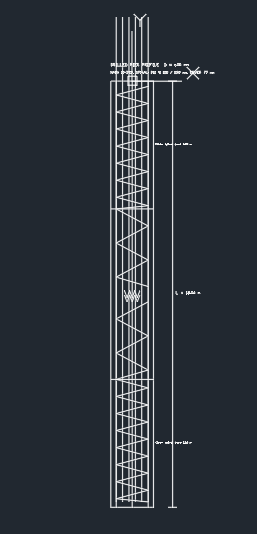
The integrated pier module also generates a complete circular reinforcement layout, interaction diagram, reinforcement schedule, and engineering drawings suitable for documentation. The section drawing displayed on screen can be exported directly to DXF, allowing immediate use in CAD software for project documentation and construction drawings.

This integration transforms PILE-TOOLBOX from a collection of individual calculators into a unified engineering platform. Engineers can proceed from soil profile definition, axial pile capacity, settlement analysis, lateral pile analysis, reinforced concrete pier design, and finally construction drafting within a single project file while sharing the same soil database and pile geometry throughout the entire workflow.
By linking these traditionally separate engineering tasks, PILE-TOOLBOX provides a practical one-stop solution that improves consistency, reduces design time, and streamlines both analysis and drafting for drilled pile and bored pile foundation projects.
Pile Group Capacity and Settlement Analysis
Pile group analysis calculates pile capacity and elastic settlement by bundling individual piles. The program compute the perimeter and bearing foot print them use them for friction and bearing capacity for the pile group. The efficiency ratio (Teng, 1962) defined as
Pile group Efficiency = Load capacity of pile group/ Sum(capacity of individual piles)
*This efficiency ratio is known to be greater than 1 for a pile group in sand (bearing control) and less than one in clay as friction control. It should be noted that the bearing area of the group is much larger than the sum of the pile areas. For the pile group with dense pile spacing, the perimeter of the group can be much smaller than the sum of those of the individual piles.
The geometric properties (footprint area and group perimeter) can be easily transferred to settlement analysis. This is much more useful than the settlement calculation for a single pile.

Cantilever Pile Wall
A cantilever pile wall is used for shallow- to moderate-depth excavations. This module is for a cantilever tangent pile wall design. The program computes Rankine's earth pressure distribution for c-phi soil on the active and passive sides. The factor of safety is computed from. FS = M_resisting / M_driving about the toe point
At the toe point, a horizontal passive force is computed for horizontal equilibrium at a certain FS. The pile is extended beyond the toe (L) to accommodate this passive force. The program also provides a solver for L and D given the desired FS. Bending moment (M) and shear force (V) for each section at depth z are also calculated and can be transferred to the PM pier for structural design.

Braced Pile Wall
Optimization techniques can fine-tune the forces in props and the penetration depth to the free- and fixed-earth pile wall. The aim is to minimize the penetration depth while maintaining force and moment equilibrium in the braced-pile wall system for the target FS. The upper limit of prop reaction shall be set.
The benefit of using optimization to address those design variables is that we can treat them in a unified way across both the free-earth and fixed-earth methods without changing the algorithm. Moreover, the lateral soil pressure is identical to that of a cantilever pile wall, so it's quite simple to extend the method to a braced pile wall in less time.
EXAMPLE: 1-LAYER Braced Cut Excavation (H = 6.0 m)
Search for equilibrium of sum(M) = 0 and sum(Fx) = 0 for FS = 2.5.
Limit prop force = 250 kN/m

Interactive Visualization
Engineering calculations become much more useful when accompanied by clear graphical interpretation.
PILE-TOOLBOX provides:
Layered soil profile visualization
Settlement versus depth plots
Load-displacement curves
Pile geometry visualization
Interactive result plots
Automatic report generation
These graphical outputs improve engineering understanding while simplifying project documentation.
Practical Applications
PILE-TOOLBOX is suitable for a wide range of foundation engineering projects, including:
Industrial buildings
Warehouses
Oil and gas facilities
Pump houses
Tank foundations
Bridge foundations
Commercial buildings
Residential developments
Solar farm foundations
Retaining structures
Temporary construction works
The software is particularly useful during preliminary design, where engineers need to compare numerous foundation alternatives before detailed structural analysis.
Designed for Practicing Engineers
PILE-TOOLBOX emphasizes practical engineering rather than purely academic analysis. The software follows calculation procedures familiar to practicing geotechnical and structural engineers while reducing repetitive manual calculations. Automated reports, graphical visualization, and intuitive data entry enable engineers to spend more time evaluating engineering decisions and less time preparing calculations.
A Platform for Future Development
PILE-TOOLBOX has been designed as an expandable engineering platform. Future modules may include:
Pile group efficiency analysis
Negative skin friction
Downdrag evaluation
Static and dynamic pile load test interpretation
Pile integrity assessment
Driven and bored pile databases
Micropile design
Pile cap design integration
Reliability and probabilistic analysis
AI-assisted foundation optimization
This modular architecture allows new capabilities to be incorporated while maintaining a consistent user experience.
Conclusion
PILE-TOOLBOX is more than a pile capacity calculator—it is an integrated foundation engineering toolbox that combines geotechnical analysis, settlement prediction, lateral pile behavior, optimization, visualization, and reporting within a single environment. By bringing together these essential tools, PILE-TOOLBOX helps engineers develop safer, more economical, and better-informed foundation designs while significantly reducing design time.
Reference
WC Teng, Foundation Design, 1962
DP Coduto, Foundation Design, 2nd Ed. , Printice-Hall, 2001
BM Das, Foundation Engineering